“Media Literacy Methodology in the Digital Age” – programme for educators across Latvia
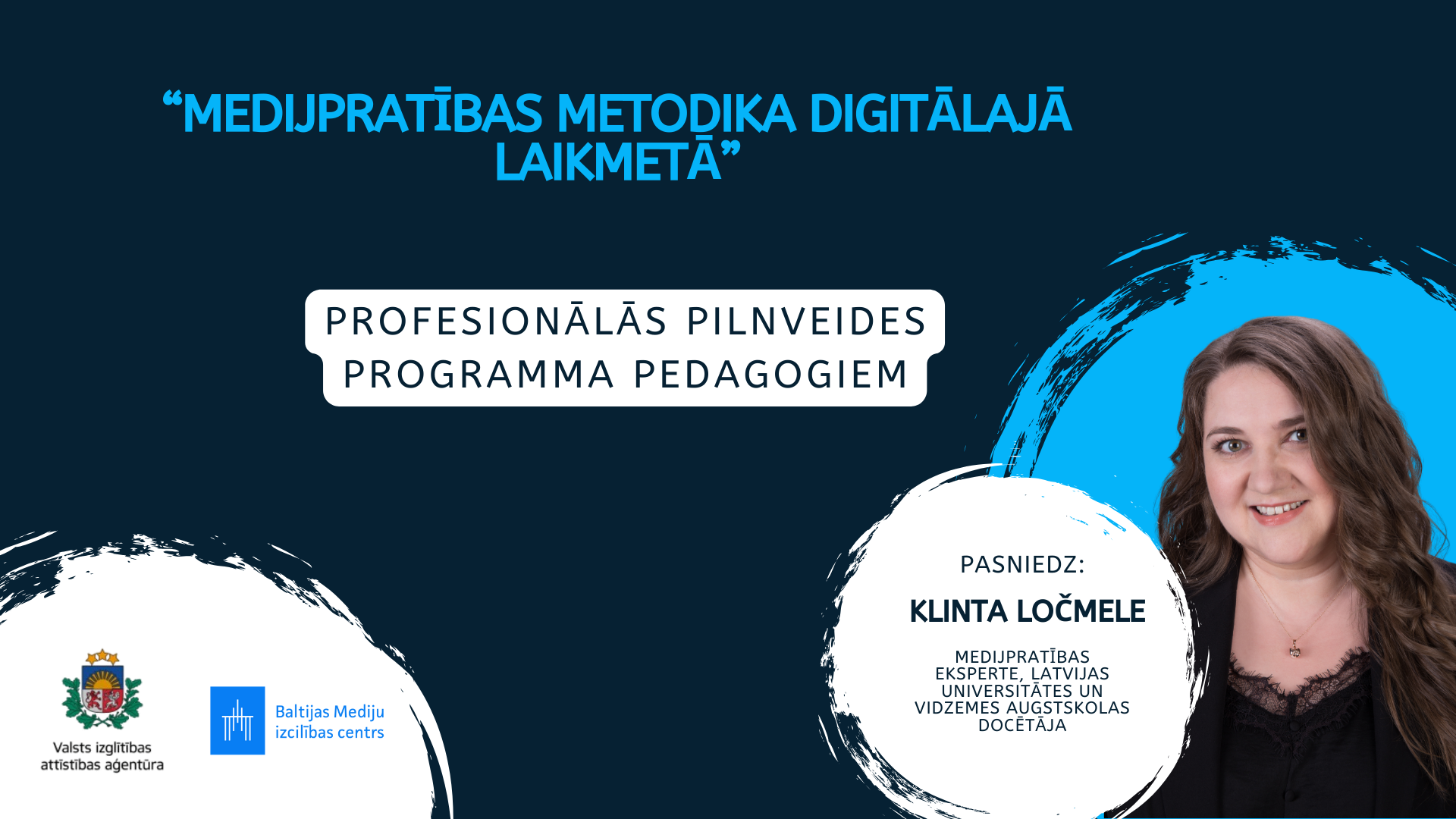
This autumn, the Baltic Centre for Media Excellence, in cooperation with the State Education Development Agency of Latvia, delivered a professional development programme “Media Literacy Methodology in the Digital Age” for educators across Latvia.
The online course brought together teachers from different disciplines to deepen their understanding of contemporary media literacy challenges and to explore practical ways of integrating media literacy into everyday teaching. The training was led by Dr. Klinta Ločmele, media literacy expert, researcher, and lecturer at the University of Latvia and Vidzeme University of Applied Sciences. Drawing on academic research, international studies, and her extensive practical experience, Dr. Ločmele guided participants through the rapidly evolving digital media landscape and its implications for children, young people, and educators.
A central focus of the course was the changing nature of media literacy. Participants explored how media literacy today goes far beyond the ability to access information, encompassing critical analysis, understanding of algorithms, awareness of commercial and political influences, and the ability to create responsible media content. Particular attention was paid to the role of social media platforms, influencer culture, and algorithm-driven content distribution, as well as the growing risks of misinformation and self-diagnosis trends online.
The programme also offered an insight into current media literacy research in Latvia, highlighting both progress and persistent gaps in knowledge – especially regarding children’s and young people’s real-life media practices. Research findings underscored the need for more systematic, skills-based approaches to media literacy education, rather than reliance on self-assessment alone.
A strong practical component ran throughout the training. Educators worked with concrete examples and teaching ideas for integrating media literacy into subjects such as arts, music, sciences, sports, and extracurricular activities. From analysing memes and TikTok videos to fact-checking visual content and discussing influencer marketing, participants were encouraged to adapt media literacy topics to their own classroom contexts.
Finally, the course introduced participants to a wide range of Latvia-based media literacy resources and educational materials, helping teachers navigate existing tools and identify those most relevant for their students. This overview reinforced the importance of collaboration between educators, researchers, public institutions, and media professionals in building a resilient media literacy ecosystem.
By combining theory, research, and hands-on practice, the training programme empowered educators to address media literacy not as an isolated topic, but as a cross-cutting competence essential for navigating today’s complex digital communication environment.