


What is the “Agentic World”?
In short, it is the new media reality.
But let’s start from the beginning.
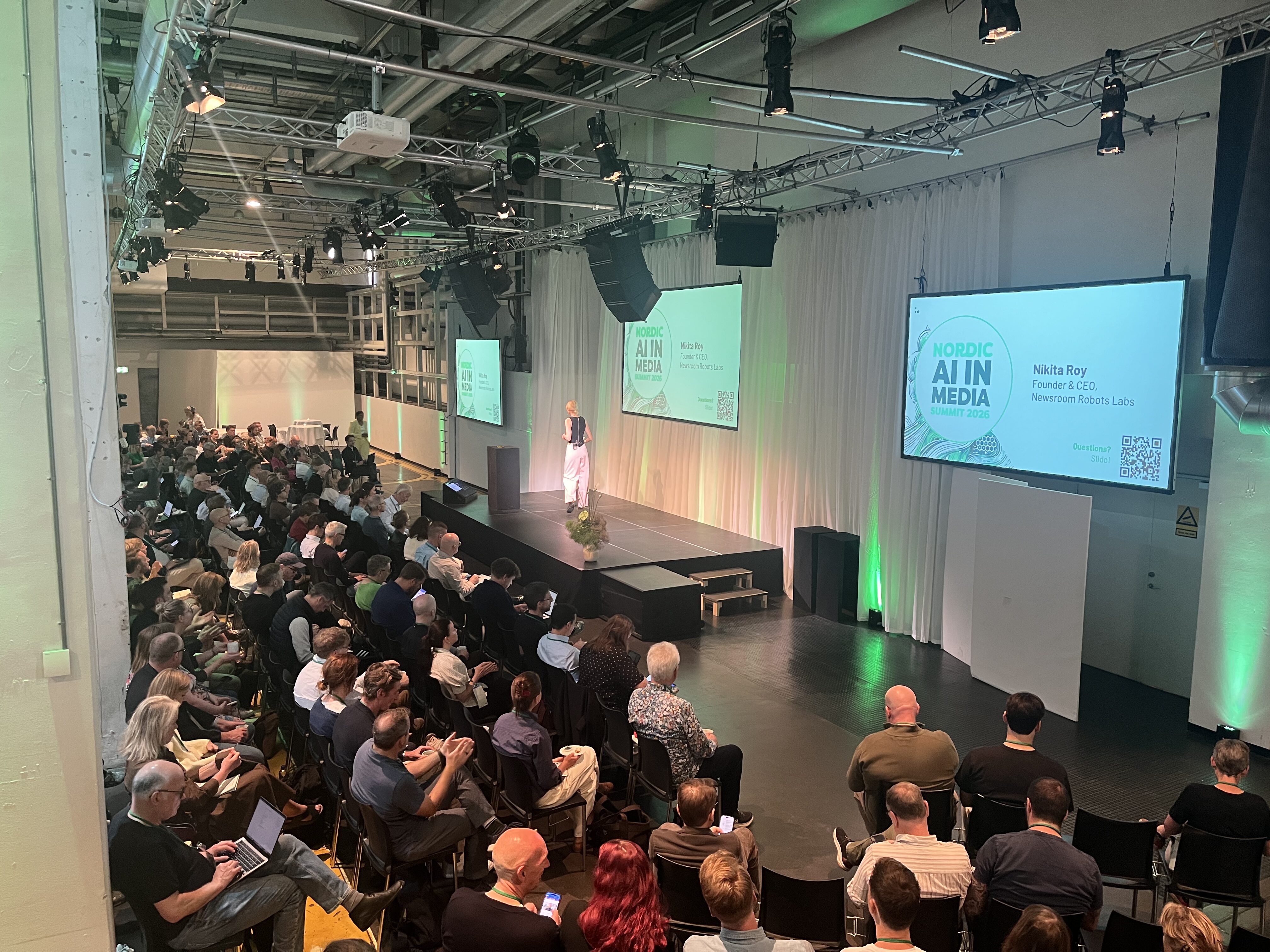
I recently had the opportunity to attend Nordic AI in Media Summit 2026 (NAMS2026), held on May 27–28, 2026, probably the most impressive conference I’ve attended lately in terms of actual substance and ideas.
Very quickly it became obvious that the Nordics are ahead of us, possibly by several steps, in how they approach artificial intelligence in media. Not only in newsroom workflows, but also in product thinking, audience engagement, and content creation itself.
Of course, there are reasons why this ecosystem works so well there. Nordic societies have relatively high trust in media and institutions, and media organizations are generally better funded. That creates an environment where experimentation, testing, and innovation are possible.
But what made NAMS2026 special was not only the content. It was also the atmosphere. The conference had an incredibly strong sense of community. At moments, it felt less like a professional conference and more like a gathering of friends who genuinely care about the future of media. People discussed, argued, shared experiences, convinced each other, agreed, disagreed, and then continued those conversations in hallways, over coffee, and during dinner.
Media’s “Nokia moment”
Still, beneath that warm and open atmosphere, there was also a clear feeling that the industry is entering a difficult transition period.
One of the strongest talks came from Nikita Roy, who described today’s media industry as being in a “Nokia and Kodak moment.”
That comparison stayed with me throughout the conference.
For years, media companies assumed that audiences would continue coming directly to their websites, apps, newsletters, and platforms. But AI is quietly breaking this assumption.
Increasingly, people no longer search for information the old way. They ask ChatGPT, Claude, Perplexity, or some other AI assistant. The interface between humans and information is changing.
And if AI becomes the interface, then media organizations lose control over distribution.
One slide stated it very directly:
“News media has lost control of distribution.”
It sounds dramatic, but honestly, it already feels true.
The conference repeatedly returned to one uncomfortable question: what does it even mean to be a media company when everyone can generate content that looks like journalism?
People don’t want news. They want meaning.
One of the most interesting insights was that people mostly do not use AI for news. They use it for practical help, explanations, recommendations, writing, technical support, and everyday problem-solving. One slide summarized it perfectly:
“Utility beats information.”
This changes the role of journalism completely.
For decades, media organizations focused on delivering information faster and more efficiently. But AI is already becoming better at summarizing, structuring, and personalizing information. The value therefore shifts elsewhere. Not toward “breaking news,” but toward interpretation, context, trust, explanation, and human perspective.
At one point, a speaker said something that may define the next era of journalism:
“People may not want news. They want meaning about the news.”
That line alone was worth the trip.
Journalism is not the container.
Another brilliant idea came from a presentation about how media formats evolved. Articles, homepages, newsletters, podcasts, and apps are not journalism itself. They are only containers shaped by the technological limitations of their time.
One slide simply said:
“We mistake the container for journalism.”
This may be one of the biggest mindset shifts AI forces upon media organizations.
Because AI makes content fluid. A story no longer has to exist only as a traditional article or homepage feature. It can become a personalized briefing, an AI-generated summary, a conversation with an assistant, or an interactive experience.
Journalism survives, but the containers are dissolving.
Enter the “agentic world.”
And this brings us to the term that appeared repeatedly during the summit:
“Agentic world.”
The idea is both exciting and slightly unsettling.
In an agentic world, people increasingly delegate tasks to AI agents. Your AI reads information for you, filters content, summarizes articles, compares sources, and recommends decisions. One speaker described a future where media agents interact directly with user agents. Your AI assistant negotiates with a media company’s AI assistant: give me the summary version for x cents, unlock the full article for x cents.
Suddenly, audiences are no longer just humans.
One slide even stated:
“Machines become the primary audience.”
That sounds futuristic, and while parts of this shift are already visible today, it is still unclear how fully such a model will actually materialize in practice.
AI makes human journalism more valuable.
Paradoxically, despite all the AI hype, the conference also reinforced something deeply human. AI cannot go to the Mexican border and interview refugees. AI cannot build trust with a whistleblower. AI cannot witness reality.
It can summarize and synthesize. But it cannot truly report from the world.
That means original reporting, field journalism, investigation, and authentic human perspective become even more valuable in the AI era.
This became especially visible during presentations from Der Spiegel and BBC Verify. Both newsrooms showed how difficult and time-consuming verification work has become in the age of generative AI. Journalists now have to verify not only manipulated photos or edited videos, but also entirely synthetic content created at scale. Verification teams increasingly investigate metadata, geolocation, shadows, weather conditions, sound patterns, and tiny visual inconsistencies to determine whether something is real.
Ironically, the more advanced AI becomes, the more valuable human editorial judgment becomes as well.
Lessons from Bergen and regional media.
One of the most practical and inspiring presentations came from Kaja Distad and Polaris Media Vest in Bergen, Norway. What made this case especially interesting was that it focused on regional media, not global tech giants.
Regional Norwegian newsrooms are already using AI to analyze public datasets, create interactive stories, automate repetitive tasks, and help journalists discover stories faster. Journalists themselves are learning “vibe coding” and using AI tools to build interactive storytelling formats without needing large development teams.
That changes the equation completely for local media. Small newsrooms suddenly gain capabilities that previously belonged only to major organizations.
And maybe this was one of the most optimistic conclusions from the summit: AI could actually strengthen regional journalism, if media organizations learn how to use it wisely.
Trust becomes the ultimate currency.
Another major theme throughout the conference was trust.
Several speakers mentioned research showing that while AI usage is rapidly growing, public trust in AI is not. In a world flooded with generated content, trust may become the most valuable product media organizations can offer.
The future battle will not simply be about who has the best AI tools. It will be about who people trust, who verifies information properly, who is transparent, and who can prove credibility.
Who shapes the future?
Toward the end of the conference, discussions moved beyond journalism and business models toward power, culture, and values.
One speaker challenged the phrase “human in the loop” with a provocative question:
| “Do we really have humans in the loop? Or do we have five men in the loop, in the USA and China?”
The point was simple: AI systems are not neutral. A small number of companies are increasingly shaping how information, communication, and even social norms work.
The Nordics have built societies based on trust, debate, education, and democratic values. But will global AI platforms reflect those same values?
AI is not only a technological shift, but also a cultural and political one.
The media industry at a turning point.
The overall mood of the conference was fascinating. It was not blind techno-optimism. It felt more like standing in the middle of a historic transition and realizing that the old rules no longer apply.
The homepage era is fading. Distribution is changing. Formats are dissolving. AI is becoming the interface to reality.
And media organizations are trying to redefine what they actually are.
Maybe that is the biggest lesson from NAMS2026: AI is not just changing journalism tools. It is changing the relationship between humans, information, trust, and meaning itself.
This article was created with a human perspective, conference notes, and AI-assisted writing support.
More about NAMS2026: https://www.nordicaijournalism.com/nams-2026
Soon, videos from the summit will be available on the Nordic AI in Media Summit YouTube channel.


